 |
| view from a bridge |
 |
| Stephania, an artist |
 |
| by the grand caanal |
The
bus passes hundreds of parked cars on both sides of the road and
crosses a long bridge over what looks like an estuary before halting
at a big circular terminal. End of road. Start of waterways and
footpaths. Welcome to Venice.
One
of the first things I notice is Santa Chiara Hotel, an old decrepit
red building with cracks and worn-off coating, across a wall full of
murals. It looks abandoned but isn’t. Further to the left is a
stylish foot overbridge with fiberglass railings arching over a
canal, a line of ferry stops, ticket counters, buses, shops and a lot
of people, mostly tourists. On the other side of the canal there’s
a big building, perhaps the railway station. It's a rare sunny day in
the first week of March. Cold breeze carries the salty smell of sea.
I move closer through tens of visitors and touts to see the Grand
Canal, busy with ferries and boats, disappear into a city of grand
palaces, statues and churches on either side.
A
picture postcard. Venice is full of it. Look around from anywhere in
those narrow streets or waterways, or from one of the several arch
bridges, or anywhere by the canal—it will look like a painting,
beautiful, grand and, yes, with clear signs of decadence.
The
land of Marco Polo has it all.
All
its grandeur maybe like a beautiful Venetian mask; underneath, the
city, the real face, may be crumbling. But here, mask is part of the
face and life is part of the show. The cracks on the buildings and
bridges and their peeled off coatings are as much part of Venice’s
beauty as its magnificent palaces, churches and museums,
architecture, statues and art work.
They
are all brought together and mixed and blended into a marvelous
dream-like experience by water that reaches every part of the city
through wide and narrow canals.
It’s
hard to say if Venice is a floating city or a sinking one. It’s
hard to say if water will slowly consume it or help it grow. Perhaps
uncertainty is part of Venice’s beauty.
My
nostalgia over a childhood spent in Kerala backwaters may have
influenced my instant love for Venice. But I’ve never felt more at
home, more relaxed, in any other global city.
Is
there any other city where there is not a single vehicle in the
streets, not even a bicycle? I don’t remember seeing a single
policeman in Venice either, though I did see a couple of police
boats.
Get out of water and walk the narrow streets past countless souvenir shops selling Venetian masks and Murano glass jewellery works, high-end retail outlets, cafes and bars that have set tables on the streets, happy tourists, hugging couples, smiling street musicians playing accordion and guitar, probing roadside vendors, including several Bangladeshis and Blacks, and some jobless folks who asks for a fag as soon as you light one, to the grand squares, palaces, churches and museums, and get lost in the perfection of murals, paintings, sculptures and architecture, or get mesmerised by the minute details of masks, glassworks and jewellery. Or, feed parrots at Saint Mark Square—it’s wonderful though the birds seem to have a clear preference for girls, as they refused to bite on a piece of bun I offered until I threw it down. Or, sit by the canal watching boats and birds and buildings, people and water. Eat you food, drink your drink, take your time.
Venice
is made up of more than a hundred small islands in the Venetian
lagoon connected by bridges on the Adriatic Sea in northeast Italy.
It was first built in early fifth century when several mainland
Italians decided to settle in the salty water lagoon from fear of
invading barbarians. The buildings here stand on thousands of closely
spaced wooden pilings driven into the mud. Then they were sawn on top
to make a flat surface. Most building in Venice today stand on piles
sunk more than 1,000 years ago.
Venice
has many landmarks—Doge’s Palace, Piazza San Marco, Rialto
Bridge, world’s first Jewish ghetto Sotoporto, Santa Maria Della
Salute Basilica, Murano island, Mozart’s residence, Harry’s Bar….
But
the place is not about going from place to place, crossing out “must
see, must do” items one by one. Venice is more about relaxing and
doing things at your own pace. About walking around and getting used
to the slow pace of life on water, to let yourself float like gentle
waves, directionless.
Walk away from the main streets to inside the city without any particular destination. That’s when you discover the life in Venice. You’ll cross small bridges and canals, see the yellow and pink buildings where people live, flower vases on their windows, clotheslines outside them. You’ll see small squares where kids play and elders sit around cafes and shops. You’ll reach dead-ends facing narrow canals where people park their boats. You’ll see men and women rowing or motoring away to work. You’ll see parents and grandparents taking kids out on a walk. You’ll see old Jewish ghettos and new ones. You’ll see people go to market and laugh out loud.
If you get lost and ask for help, you’ll realize that most locals don’t understand English. Then you repeat words like “ferry”, “station”, “boat”, “vaporetto”. And they will tell you in their sweet local language where the nearest ferry stop is amidst roars of laughter . You may not get a clear idea, but don’t worry, move on; the ferry is never too far.
In one of those walks we come across Stephania selling her paintings in a square. She studied in an art school in Venice, and her paintings are beautiful, with arch-shaped bridges, yellow and pink buildings, colonnades, landmarks, gondolas, the sky and reflections on wavy water in brilliant water colours. She sells them for around 20 euros each. She looks happy. Beautiful life, I think.
Another artist we met is Rsgar who makes and sells masks from papier-mache at his studio shop. Venetian masks--many sporting florid designs and bright colours such as gold and silver, and decorated with fur, fabric and feathers—have their own magic world and a long history. People in the city actually used to wear masks to hide their identity and social status and, of course, it helped them involve in non-social activities. Sorry, those days of masqueraded fun are gone. Anyway, this day, Rsgar introduces us to several popular masks such as the Casanova mask, Pierrot and Joker. We are lost in the details of their design and stunning colour combination. He says he takes about four hours to finish one mask. He charges 30-50 euros each.
On a Sunday morning, walking the streets of a residential area, we notice that Venetians are not much into television. We see people sitting outside their houses, drinking coffee or tea and staring at the water. We see young fathers playing with their little ones. We drink coffee from a small shop. We sit outside by the canal. Some locals are there. They are friendly and courteous. On higher floors, windows are open. We hear children and grown-ups, but we don’t hear any television. Almost every house has TV antennas outside, but who needs TV here on a beautiful Sunday morning?
The gondola boatmen are unique. Almost all of them wear that typical T with horizontal stripes. Some wear round straw hat, some others sport shaved heads, almost all use dark sunglasses. They hum and they whistle and they always offer you a ride if you look at them. We ask the rate and one of them says it's 80 euros for 35 minutes. I ask if he would sing, “Do lafzon ki hai dil ki kahaani…” song in Amitabh Bachchan’s The Great Gambler playing in my mind. “In the opera house,” he says in his masculine voice, grinning.
We did hear a song from a gondola. But it isn't the boatman singing. It's a bulky man standing on the gondola comfortably and singing in the highpitched voice of an opera singer. His voice stay in the air and set the background for several minutes. We feel good.
Most local men and women are not really sophisticated. Of course, those in designer shops and big showrooms are suave. But most those you find on the streets come across as plain people. The language itself is let’s say a bit naïve. It’s a pleasure to hear them say “grappa” without ignoring a single letter, giving due respect to the “r” and the second “p”; it’s almost like caressing that word or, in this case, caressing a bottle of grappa, which is a local drink. The drink itself is not very smooth, but it has the Venetian flavour and it’s a pleasure saying “gurrappah”, be it in a bar or a supermarket.
Well, bars in Venice—as most cities of the world—are a bit expensive for people who don’t count their drink. So we largely bought our drink from supermarkets and kept it in our bag. Readymix :). Nobody minds if you drink or smoke in some corner. And, cheers, there are no probing policemen.
One problem with frequent boozing is frequent leaking. And that’s not cheap as I realised in my only trip to a public toilet in Venice. Like metro stations, there are barriers at the entrance. You insert one and half euros and it opens. I put in two coins of one euro each and waited for the change. The door opened, but no change. A woman there tells me the machine doesn’t return money, I could have taken change from her. At two euros, or almost Rs 140, that must be my most expensive leak.
I
never went back to a public toilet. Of course not. I’d rather spend
three or four euros in a beer or a drink and use the loo in a bar.
I could never make out the real feeling of local people towards tourists. Obviously tourists are ruling the place, going wherever they feel like, having fun and clicking photos, and perhaps restricting the locals and denying them privacy. The old people may be missing certain things and traditions, but not many people could be complaining. After all they live off tourism, making and selling masks and glassworks and other stuff for tourists, renting out rooms, running bars and restaurants, rowing gondolas and riding water taxis and ferries…
So tourists are always welcome, provided they don’t dirty the place. Venice is very clean. Spick and span, streets and waterways. It’s a surprise, almost a wonder, to see a place so full of water to be without mosquitoes and flies. Kerala should do a study on how Venice is managing its waste, wastewater, drainage and drinking water systems. And, of course, making visitors feel at home.
 |
| an old woman hanging clothes |
 |
| the bridge near the bus stop |
 |
| a tourist feeding parrots at st mark's square |
 |
| Rialto bridge in black & white |
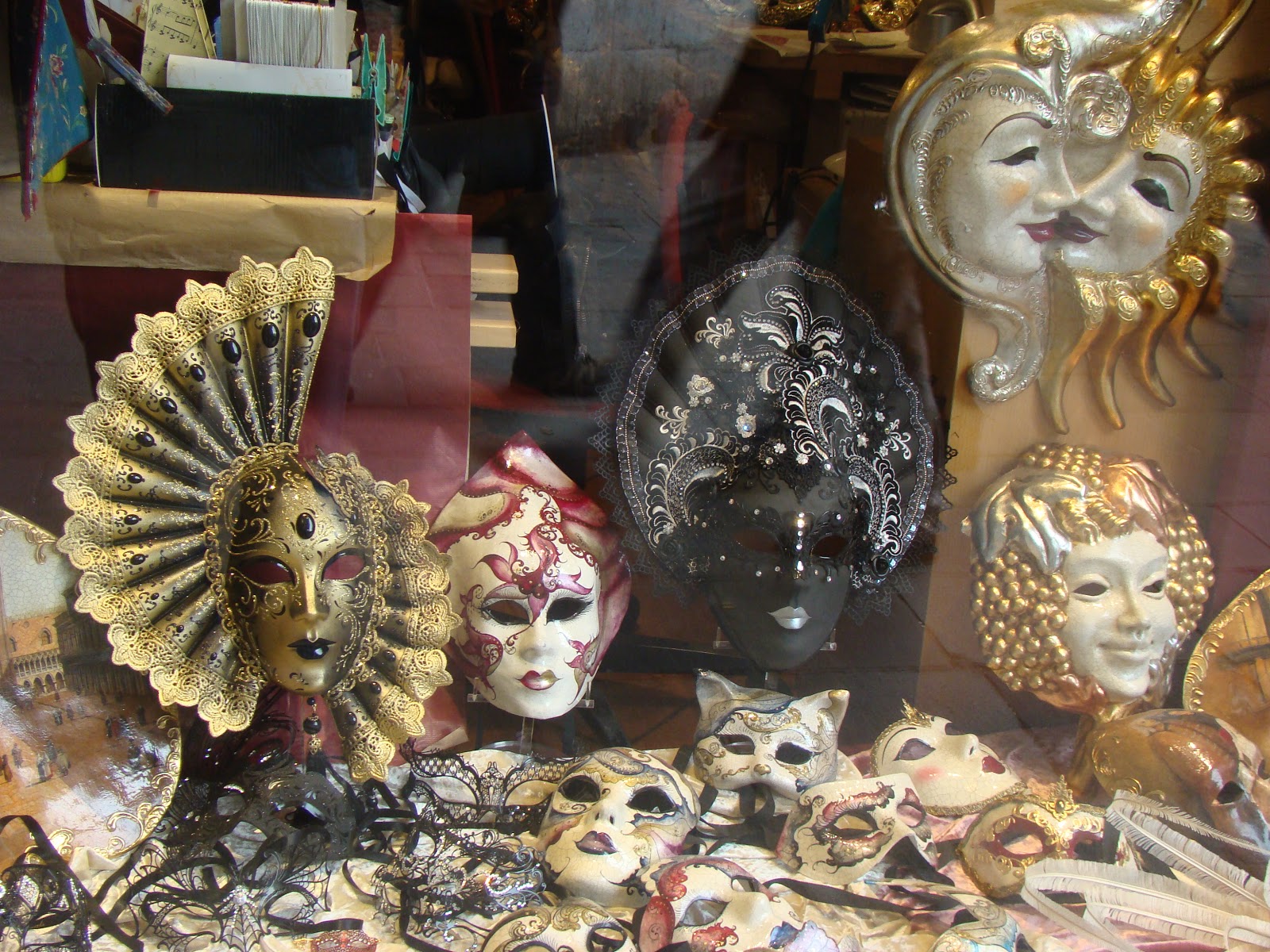 |
a shop window |


